
Strategy Governance
Executive and Participative Governance from the Boardroom to the Front Line
Most organisations do not lack strategy documents. They lack strategy governance.
They have plans, priorities, strategic themes, transformation programmes, operating plans, review meetings and dashboards. Yet strategy still, too often, feels ambiguous, weakly owned and unevenly enacted. Senior leaders may believe the strategy is clear, while those expected to interpret and deliver it experience something more like a fog: uncertain authority, unclear contribution, limited voice, and a recurring need to seek permission upward for decisions that ought to be made closer to the work.
That is why strategy governance matters. Strategy governance is what turns strategy from a shifting, ill-defined idea into something that can be directed, coordinated, monitored and made real. Earlier work by the author described robust strategy governance as the means by which an organisation blows away the “shifting sands” of ambiguous strategy and creates the bedrock for its systematic management (Baxter, 2020).
Strategy governance is the means by which an organisation exercises authority to make a concentrated and coordinated effort toward strategic success. It works by structuring authority and defining roles, by setting goals and the rules under which they are pursued, and by establishing systems for tracking, reporting and enforcing commitments to strategy (Baxter, 2020).
But that definition needs extending. Strategy governance is not only about how the board and senior leadership team govern strategy. It is also about how to govern the ways in which people across the organisation contribute to strategy. It is about how those people are informed, consulted, trusted, empowered and held accountable for shaping, interpreting, adapting and advancing strategic change. In other words, strategy governance has two inseparable domains: executive governance and participative governance. The first governs strategic authority at the top. The second governs strategic contribution throughout the organisation (Baxter, 2020; Baxter, 2022).
Executive governance commits the organisation to a direction. Participative governance determines how the organisation contributes, learns, adapts and makes its direction real.
What strategy governance is
Governance, in general, is often treated too narrowly, as if it referred only to the formal rules of engagement between boards and executives. In practice, governance is broader. It concerns who has authority, how that authority is exercised, what is monitored, how decisions are made, who is involved, how accountability works, and what happens when reality diverges from intention.
Within strategy, those questions become especially important because strategy is not business-as-usual. Strategy is about the future, about change, about the allocation of scarce attention and resources toward a chosen direction. In my earlier framework, this led to a distinction between two objectives of strategy governance. First, strategy governance commits the organisation to a future destination. Second, it seeks to ensure that best endeavours are made to get there. The first is the executive domain; the second is the wider organisational domain (Baxter, 2020).
This means strategy governance is not the same thing as corporate governance in general, nor is it reducible to compliance, risk management or performance reporting. Those are adjacent governance domains. Strategy governance is specifically concerned with how authority and organised effort are aligned in pursuit of strategic success (Baxter, 2020).
The modern benchmark: ISO 37000 and the purpose-led pivot
Any contemporary guide to strategy governance should reckon with ISO 37000:2021, the international guidance standard on the governance of organisations. ISO describes it as guidance applicable to all organisations, regardless of type, size, location, structure or purpose, and says it provides principles and key aspects of practice to help governing bodies meet their responsibilities so that the organisations they govern can fulfil their purpose (ISO, 2021a; ISO, 2021b).
This matters because ISO 37000 shifts the centre of gravity of governance. It presents purpose as primary. In the official standard preview, ISO states that “the pursuit of purpose is at the centre of all organizations” and that good governance lays the foundation for fulfilling that purpose “in an ethical, effective and responsible manner in line with stakeholder expectations” (ISO, 2021c). The standard also highlights three core organisational outcomes of good governance: effective performance, responsible stewardship and ethical behaviour (ISO, 2021c).
That is a significant pivot. A narrower shareholder-first reading of governance tends to make strategy governance look like the optimisation of financial interests through control, oversight and investment discipline. ISO 37000 broadens the frame. It places governing bodies under a responsibility to clarify purpose, align strategy with that purpose, and govern in a way that generates value appropriately for stakeholders rather than treating value creation as synonymous with short-term shareholder return (ISO, 2021d; ISO, 2021e).
Wider ISO 37000 guidance materials (ISO, 2021d; ISO, 2021e) clarify that the standard is built around 11 principles, including purpose, value generation, strategy, oversight, accountability, culture, stakeholder engagement, leadership, data and decisions, risk governance, and social and environmental context. For the purposes of strategy governance, four implications are especially important.
First, strategy becomes inseparable from purpose. Strategy is not simply a competitive or financial plan; it is how the governing body steers the organisation toward the fulfilment of its purpose over time (ISO, 2021d).
Second, oversight becomes active rather than passive. Governing bodies are not there merely to approve and receive reports; they are expected to oversee performance, accountability and stewardship in a continuing way (ISO, 2021a; ISO, 2021d).
Third, stakeholder engagement becomes a governance issue, not just a communications issue. ISO 37000 treats organisations as operating within a wider social and environmental system, requiring governing bodies to understand stakeholder expectations and take them seriously in how value is generated and sustained (ISO, 2021b; ISO, 2021d).
Fourth, data is recognised as a governance resource. ISO 37000 explicitly connects governance to the responsible use of information and data in decision-making, which is a notable expansion of what counts as strategic stewardship (ISO, 2021d).
This aligns with the broader shift toward purpose-centred governance reflected in the World Economic Forum’s stakeholder-capitalism agenda. The WEF’s 2021 reporting on the Davos Manifesto stated that the definition of governance is evolving as organisations are increasingly expected to define and embed their purpose at the centre of their business (World Economic Forum, 2021a). That does not replace the need for executive and participative strategy governance. It strengthens the case for them. ISO 37000 gives the article a normative benchmark: strategy governance is not just about efficiency and control, but about legitimacy, stewardship and trust.
The two domains of strategy governance
The first domain is executive governance of strategy. This is how the board and senior leadership work together to govern strategic direction, sign-off, strategic planning, strategic risk and strategic progress. It includes agreeing the scope of strategy, approving the strategy itself, approving the strategic plan, initiating strategy review, and maintaining oversight of risk and progress across the strategy lifecycle (Baxter, 2020).
The second domain is what I originally called working governance of strategy and now prefer participative governance of strategy. In the earlier formulation, working governance was concerned with ensuring that people and teams across the organisation knew about strategy, were committed to it and were empowered to contribute to its success (Baxter, 2020). In later writing, this evolved into a richer idea of participation: governance not just through compliance or engagement, but through distributed authority, trust, autonomy and meaningful involvement in shaping outcomes (Baxter, 2022).
The shift matters. “Engagement” is valuable, but it can still sound passive. People can be engaged with a strategy they did not shape, cannot influence and are not trusted to adapt. Participative governance is stronger. It names the governance of contribution itself.
Why executive governance alone is not enough
Executive governance is necessary, but it is not sufficient.
A board can approve a strategy. A senior leadership team can sponsor it. A strategy office can coordinate it. None of that guarantees that strategy will be interpreted intelligently, challenged productively, improved by local knowledge or adapted well in the face of changing circumstances.
For that, the organisation needs conditions under which people can speak up, test assumptions, discuss trade-offs, surface risks, share learning and act with bounded autonomy. Recent research strongly supports the importance of those conditions. Edmondson and Bransby’s review of psychological safety identifies four major themes in the literature: getting things done, learning behaviours, improving the work experience, and leadership. It also reports a systematic search of 185 empirical articles, reflecting how established and substantial this research field has become (Edmondson and Bransby, 2023).
The CIPD’s 2024 evidence review reaches a similarly practical conclusion: trust and psychological safety are linked to a wide range of positive outcomes, including individual attitudes, team behaviours and environment, and overall performance (Wietrak and Gifford, 2024).
The implication is clear. Executive governance without participative governance risks producing formal alignment without enough organisational intelligence.
Executive governance in detail
Executive governance is not a single board approval meeting. It is a governed sequence of key reviews and commitments across the strategy lifecycle.
The first key point is strategy scope sign-off. Before strategy production begins, there must be alignment on what is being produced. Is this a three-year strategy or a five-year one? Are vision, mission and values being revisited? What level of investment is likely to be available? Without this early clarity, strategic work can drift or be forced into late-stage renegotiation (Baxter, 2020).
The second point is strategy sign-off. Once the main work of strategy development is done, the board and senior leadership need to review not only the wording of the strategy but the robustness of the process behind it: what options were considered, what evidence was used, what strategic choices were made, what validation was undertaken, and what risks attend the chosen direction (Baxter, 2020).
The third is strategic plan sign-off. Strategy does not become governable simply because it has been written. There must be agreement on how strategy will now be enacted and governed: what will be reported routinely, what kinds of deviation or risk will trigger further discussion, and how the relationship between board oversight and executive action will work in practice (Baxter, 2020).
The fourth is strategy review initiation. Every strategy needs a governed route to renewal, revision or termination. This may happen because a strategy has reached its planned end, because it has achieved its objectives early, or because it is failing to do so. Review is not an admission of weakness. It is part of governing strategy responsibly (Baxter, 2020).
Across all four lifecycle sign-offs sit two continuing responsibilities that run through the strategy lifecycle rather than marking discrete points within it: strategic risk oversight and the tracking and reporting of strategic progress (Baxter, 2020).
Strategic risk oversight is not the same as operational risk management. Operational risk concerns the hazards of day-to-day execution: compliance failures, system outages, personnel issues. Strategic risk concerns the threats to the strategic direction itself — the risk that the chosen strategy is wrong, that the environment has shifted faster than the organisation has recognised, or that execution is diverging from intent in ways that will not be caught by routine performance metrics. These risks require their own governance provisions. They must be named, reviewed regularly, and connected to clear escalation triggers rather than left to emerge as late-stage crises (Baxter, 2020).
The tracking and reporting of strategic progress is what keeps governance continuous between the four sign-off points. The strategic plan sign-off establishes what will be tracked and how often — but that decision needs to be made carefully, because a badly designed reporting system creates the illusion of strategic oversight without the reality of it. Tracking too many metrics produces noise. Tracking operational metrics in a strategic reporting system confuses the question. The governance challenge is to agree, as part of the strategic plan sign-off process, on a small set of strategic indicators that actually signal whether the strategy is working, accompanied by clear criteria for what constitutes normal progress, what constitutes concern, and what would trigger a board-level response rather than routine executive management (Baxter, 2020).
This last point matters more than it is usually given credit for. Most organisations conflate the routine performance review with strategic governance. They are different. The routine performance review tracks whether the organisation is performing well within its current strategy. Strategic governance asks the harder question: whether the strategy itself remains the right one. Both are necessary, but they require different questions, different data, and different forums. A senior leadership team that reports primarily on operational performance to a board that wants strategic insight will eventually produce a governance relationship in which the board is kept informed but not genuinely overseeing.
This is where the strategy governance charter becomes so useful. The charter is the instrument that clarifies, at the level of principle, how board and senior leadership align across the strategy lifecycle: who leads what, what is signed off, how risk is handled, how progress is tracked, and under what circumstances governance shifts from routine review to deeper intervention (Baxter, 2020).
From working governance to participative governance
My earlier account of working governance distinguished between two principles: enforcement and engagement. Enforcement governs through rules, formalities, compliance and control. Engagement governs through co-created goals, norms and conventions that people understand, commit to and act on. The argument then was that both have a role, but that governance should, wherever possible, default toward engagement (Baxter, 2020).
That remains broadly right, but participation is the stronger term.
Participation makes explicit that governance below the executive level is not merely about securing buy-in. It is about giving people meaningful ways to contribute to strategic change. It is about ensuring that people understand enough, influence enough and are trusted enough to help strategy succeed.
This aligns closely with Kamer’s description of participatory governance. He argues that many organisations default to a permission culture, in which people assume they cannot act unless authorised. Progressive organisations invert that assumption: people can act unless a specific policy or agreement prohibits it, with authority distributed as close as possible to where information and action sit (Kamer, 2021). That is not an argument against governance. It is an argument for designing governance differently.
Hamel and Zanini’s Humanocracy extends the wider critique of bureaucracy and argues for organisations that distribute initiative and judgment more widely rather than concentrating authority unnecessarily (Hamel and Zanini, 2025). Clay Parker Jones’s Hidden Patterns adds a contemporary organisational-design lens built around practical patterns for shaping how work actually works (Parker Jones, 2026).
The relationship between enforcement and engagement is not a dial to turn from one to the other. It is structural. Different levels of the organisation, and different stages of strategic action, require different balances of the two.
The architecture of strategic governance
It may be useful at this stage to introduce a visualisation of strategic governance. Figure 1 shows strategic governance comprising two concentric rings. The outer ring is executive governance and the inner one is participative governance: participative governance needs to work within the bounds set by executive governance. The spokes connecting the two rings represent each ring being informed by the insights, actions and outcomes of the other ring.
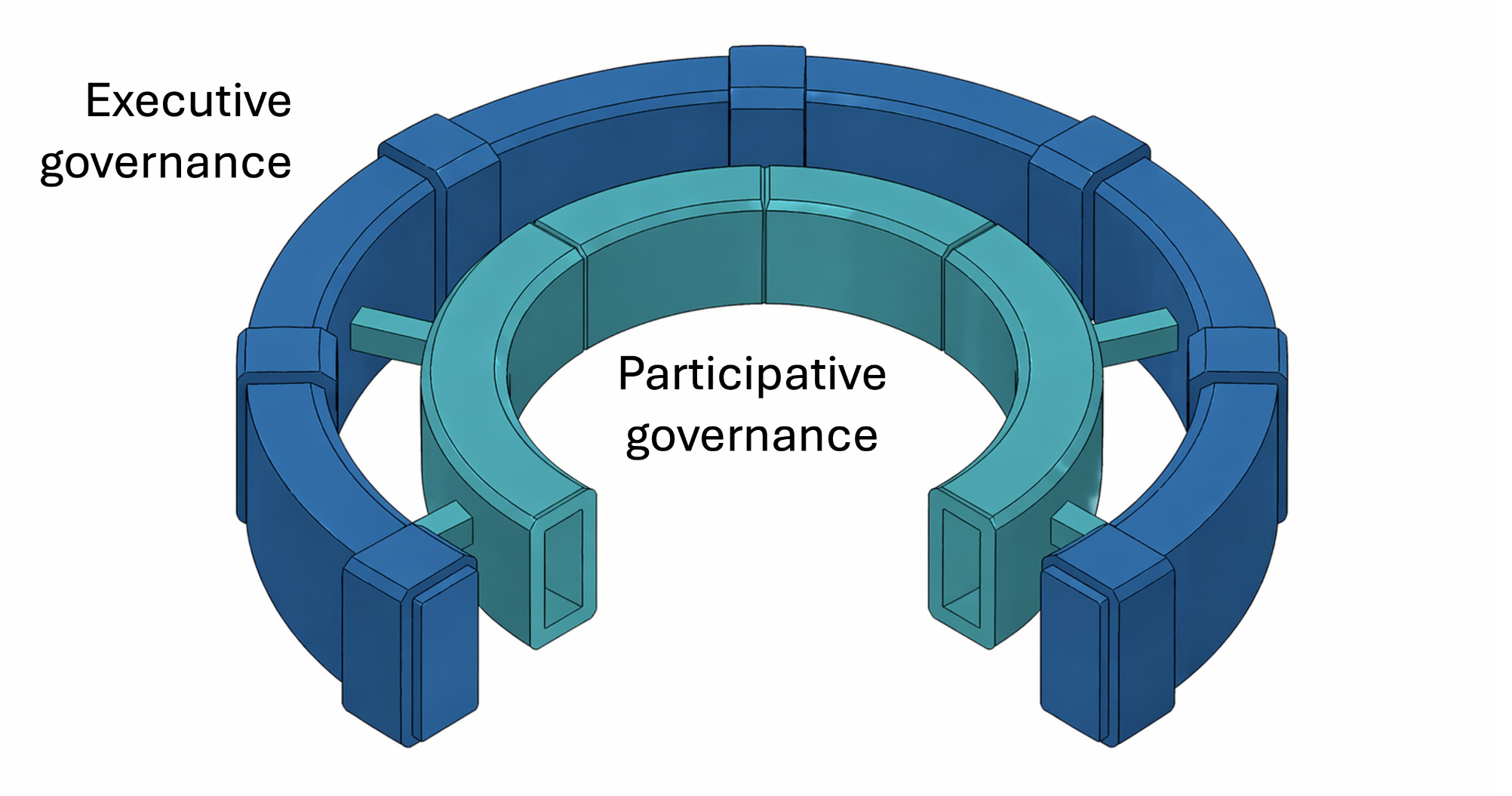
Figure 1. A two-ring model of strategic governance. Executive governance (blue outer ring) establishes the perimeter within which the participative governance (green inner ring) operates. The connections between the two rings indicate the points of review and sign-off throughout the strategy lifecycle, where executive governance formally engages with participative governance.
Figure 2 below sets out to show that the participative governance of strategy is a delicate balance between enforcement and engagement. Nowhere makes this clearer than ‘accountability’. This is an enforcement mechanism when a strategic goal is delegated to you with the expectation that a performance target will be reached by a specified date. Yet, unless you feel a sense of ownership for the goal, you won’t actively problem-solve your way to achieving its target. You won’t study its circumstances to learn why it hasn’t been achieved previously. You won’t push for the breakthrough no one before you has managed.
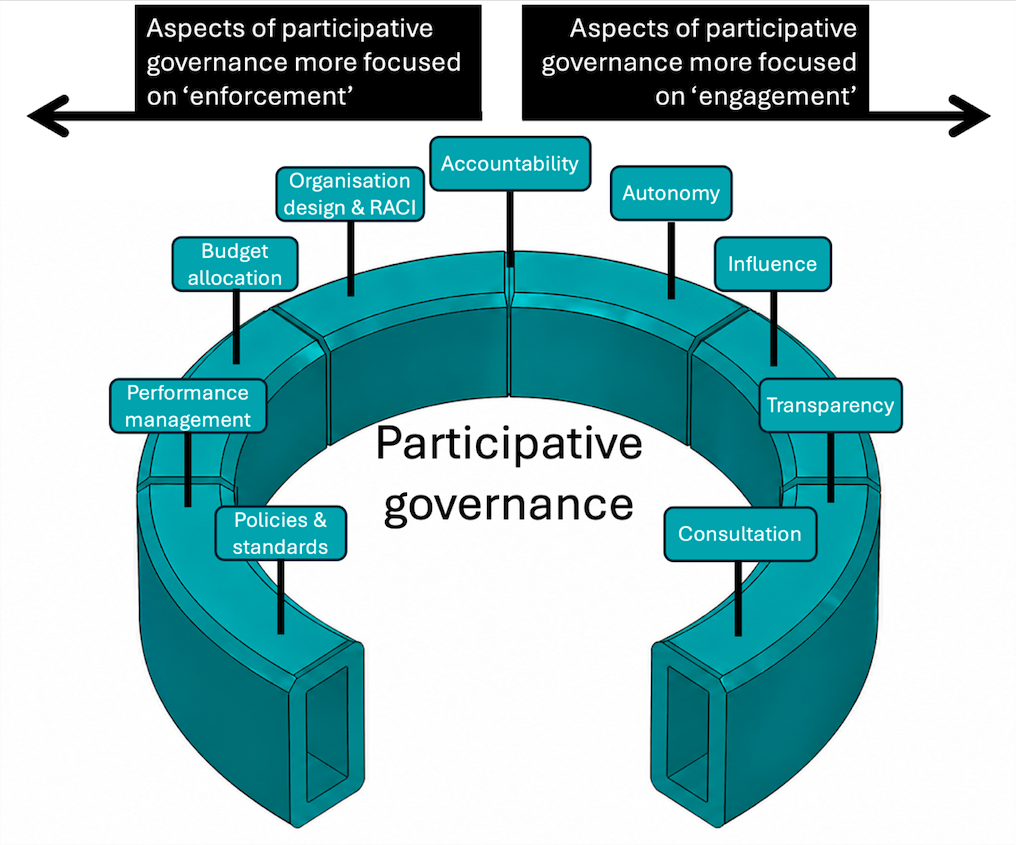
The following nine facets of participative governance should not be understood as a checklist. They describe the conditions under which distributed contribution becomes governable rather than chaotic. Put differently, they explain how an organisation can widen participation in strategy without dissolving strategic discipline.
1. Policies & standards
Policies and standards are the most explicitly constraining of the nine facets. Policies define what cannot be done; standards define how things must be done when they are done. They mark the perimeter of legitimate action.
In participative governance, policies and standards play a particular role: they make autonomy safe. Kamer’s framing (agency by default unless a policy or agreement says otherwise) depends on policies being explicit, current and proportionate (Kamer, 2021). Where the perimeter is clear, people can act inside it without seeking permission for every step. Where it is vague, every decision becomes a judgement about whether to ask, and most organisations resolve that ambiguity by asking … which quietly collapses autonomy.
The risk with policies and standards is not their existence but their drift. Policies accumulate. Standards harden into rituals long after their original rationale has lapsed. In a participative frame, policies and standards need their own governance: a discipline of review, retirement and refresh, so that the perimeter remains fit for purpose rather than expanding to fence in every past mistake. ISO 37000 makes this point in the language of governing bodies: oversight includes the oversight of the rules under which oversight is exercised (ISO, 2021a).
2. Performance management
Performance management is how an organisation answers the question: are we doing what we said we would do, and is what we said still right? Both halves of that question matter. The first is performance review in the conventional sense: targets, metrics, evidence, consequence. The second is strategic adaptation: whether the goals themselves still reflect reality.
In an enforcement-only frame, performance management runs in one direction. Targets cascade down; results report up. In a participative frame, it runs in both directions. People closest to the work contribute not only to whether targets are met but to whether they remain the right targets. This is where performance management depends on influence and transparency. Without influence, frontline insight about misaligned metrics has nowhere to go. Without transparency, leadership cannot tell the difference between a target being missed and a target being wrong.
Goal-setting research bears on this. Targets that people have helped shape, and that teams routinely revisit together, are more reliably pursued than targets imposed and left untouched. Performance management designed for participative governance therefore includes scheduled occasions for reviewing not only performance against goals but the goals themselves.
3. Budget allocation
Strategy without resources is rhetoric. Budget is the mechanism by which strategic intent becomes actionable, and how it is allocated is a governance question, not only a finance one. In participative governance, the question is not whether budgets should exist but how budget authority is distributed.
Centralised budget control concentrates strategic learning at the top, where the people farthest from the work must judge what to fund. Devolved budget authority places those decisions closer to where evidence accumulates, where adaptation is fastest, and where ownership is clearest. The choice is rarely all-or-nothing. Most organisations operate hybrid models in which broad envelopes are set centrally and allocation within them is delegated.
Budget allocation also signals what an organisation actually values, regardless of what its strategy document says. A strategy that names innovation as a priority but funds none of it is a stated strategy without a real one. For participative governance, budget allocation is therefore the test of whether autonomy is real. Autonomy without resourcing is an invitation to fail; autonomy with resourcing is permission to act.
4. Organisation design & RACI
If consultation, influence, autonomy and transparency describe the qualities of participation, organisation design and RACI describe its structure. Strategy cannot be governed participatively without explicit clarity about who participates in what, in what role, and at what point. Without that clarity, distributed contribution becomes either duplication or omission, and both quietly corrode strategic discipline.
Organisation design sets the broad pattern: which functions exist, how they relate, where decision rights sit, and how work moves between them. RACI sharpens this within and across teams — who is responsible for the work, who is accountable for the outcome, who must be consulted before decisions are made, and who must be informed once they are. Together, they convert the abstract ambition of “wider participation” into something operable.
The risk is treating organisation design as a control instrument only — a way to constrain rather than to enable. Well-designed structures do the opposite. They protect the conditions under which consultation, influence and autonomy become routine rather than exceptional. Parker Jones’s argument applies here too: the patterns beneath formal structures matter as much as the structures themselves (Parker Jones, 2026). A clean RACI on paper produces little if the underlying patterns make consulted parties feel decorative.
5. Accountability
Accountability sits at the apex of Figure 2 because it belongs to both halves. The four facets approached so far — policies and standards, performance management, budget allocation, and organisation design and RACI — establish the conditions under which accountability can be enforced. The four that follow — autonomy, influence, transparency and consultation — establish the conditions under which accountability can be felt. Both routes lead to the same place: people doing what they said they would do, and being answerable for the result.
Participative governance is not governance without consequences. It is governance that distributes contribution while preserving clarity on responsibility, review and standards. People need to know what they are responsible for, how their contribution links to larger strategic goals, what evidence will be used in review, and what happens when commitments are not met or assumptions prove wrong.
This applies upwards as well as downwards. Executive governance is accountable for the coherence, legitimacy and stewardship of strategy. Participative governance is accountable for the quality of contribution, adaptation and enacted commitment across the organisation. Where accountability is treated as enforcement only, it produces compliance without ownership. Where it is treated as engagement only, it produces ownership without consequence. Both failures undermine strategy. Effective accountability operates in both registers at once.
6. Autonomy
Strategy only becomes real when people are able to act on it. If every non-routine decision must travel upward for permission, strategy slows, local initiative collapses, and the organisation teaches people that compliance is safer than judgment.
Autonomy is often misunderstood as independence. It is better understood as bounded self-direction: people have room to decide, test, improve and respond within a clear strategic frame. That is why autonomy depends on the other facets. It is strongest when people understand the strategy, when they have genuine influence over how it lands in their context, and when accountability is explicit.
Kamer’s account of participatory governance is particularly useful here. He frames progressive organisations as replacing a default assumption of permission with a default assumption of agency, unless a policy or agreement says otherwise (Kamer, 2021). Parker Jones’s work adds a practical organisational-design lens: beneath formal structures lie recurring patterns that shape who holds power, how decisions move, and whether work becomes adaptive or brittle (Parker Jones, 2026). Together, these sources strengthen the case that autonomy is not a cultural nicety. It is a design question. Organisations either create patterns that enable responsible judgment near the work, or they create patterns that force dependence on distant authority.
Hamel and Zanini reinforce the point at the level of organisational philosophy. Their critique of bureaucracy is not simply that it is slow, but that it suppresses initiative, underuses intelligence, and treats judgment as something to be centralised rather than cultivated widely (Hamel and Zanini, 2025). In strategy governance terms, that means autonomy is not a concession from authority; it is one of the conditions under which strategy becomes capable of learning.
7. Influence
Where autonomy is the right to act, influence is the right to shape what is being acted on, by oneself and by others. Influence means that contribution can genuinely shape outcomes in proportion to role, expertise and proximity to the work. It does not require that everyone decide everything. It requires that the structure of participation is real. Strategic influence might mean shaping local priorities, challenging assumptions in a draft strategy, adapting delivery methods, surfacing emerging risks, or helping redefine the metrics by which progress is understood.
This is where participative governance becomes more than a softer version of executive governance. It is not about universal consensus. It is about widening the set of people who can materially affect strategic choices within defined bounds. The literature on ‘team-reflexivity’ (how teams examine and adapt their own work) is helpful here. Leblanc et al. (2024) show that leaders who support active participation in discussion and decision-making improve team psychological safety and reflexivity, which in turn support performance. Influence is therefore not simply a moral good; it has practical consequences for the quality of strategic adaptation.
8. Transparency
Participation without visibility is weak because people cannot contribute intelligently to a strategy they do not understand. They need to know what the strategy is trying to achieve, why certain trade-offs have been made, what constraints exist, what counts as progress, and where uncertainty remains.
Transparency matters for two reasons. Firstly, it enables people across the organisation to interpret strategy in context rather than as a slogan. Secondly, it allows governing bodies to see how strategy is being understood, challenged and adapted in practice. Transparency is therefore both a participation mechanism and an oversight mechanism.
This is one place where ISO 37000 usefully sharpens the discussion. Its emphasis on oversight, stakeholder expectations and the responsible use of data implies that governing bodies need visibility not only into financial results but into the wider evidence base through which purpose, value generation and strategy are being interpreted and pursued (ISO, 2021a; ISO, 2021d).
9. Consultation
Consultation is the most enforcement-flavoured of the engagement facets — not because it is rigid, but because it leaves the locus of decision-making intact. People are asked, their views are weighed, but the authority remains where it was. That is why consultation, on its own, is the weakest of the engagement mechanisms. It is also why most organisations start there, and many never move beyond it.
Consultation matters because no executive group, however capable, possesses all the relevant knowledge needed to make strategy real. Strategy crosses functions, specialties, geographies and operating realities. People near customers, systems, delivery, regulation, markets and day-to-day work often see possibilities and problems sooner than those farther from the action. That gives consultation two roles at once. It improves the quality of strategy by widening the evidence base available to those making strategic choices. And it signals that strategy is something people can help shape rather than merely receive. In my earlier framework, consultation was one of the core mechanisms for avoiding the worst-case scenario in which significant contributors feel ignored and then disengage from the very strategy they are expected to support (Baxter, 2020).
The point, however, is not consultation in the thin sense of circulating drafts or soliciting comments once key choices are already fixed. Meaningful consultation has to occur early enough and seriously enough to change minds. This is one reason the psychological-safety literature matters. People do not contribute candidly to strategy if they expect indifference, embarrassment or quiet retaliation for raising inconvenient truths (Edmondson and Bransby, 2023).
Seen together, the nine facets form a single architecture for participative governance, not two competing ones. The four enforcement-leaning facets (1 to 4 above) establish the perimeter and structure within which contribution happens; the four engagement-leaning facets (6 to 9 above) establish the conditions under which contribution becomes meaningful; accountability (5) binds them. Each facet weakens in isolation. Policies without transparency become opaque rules. Performance management without influence becomes top-down score-keeping. Budgets without autonomy become permission slips. Organisation design without consultation hardens into hierarchy. The reverse pairings fail too: consultation without influence is theatre; influence without transparency is misdirection; autonomy without accountability is drift. Strong participative governance emerges when these conditions are designed alongside one another rather than introduced piecemeal, and when executive governance recognises that the legitimacy of its perimeter ultimately depends on the quality of contribution it has organised within it.
What the empirical evidence says about outcomes
The empirical literature needs to be used carefully. It does not prove that one named model of strategy governance is universally optimal. But it does strongly support several mechanisms central to participative governance.
Gallup’s 2024 Q12 meta-analysis reports that employee engagement is related to all 11 performance outcomes it studied, and that business or work units in the top half on engagement more than double their odds of success relative to those in the bottom half. Gallup presents this as the largest study of its kind, drawing on data from more than 100,000 teams (Gallup, 2024). The APA’s 2024 Work in America report states that psychological safety at work fosters creativity, innovation and effective teamwork (American Psychological Association, 2024). Leblanc et al’s (2024) finding (mentioned above) is particularly relevant here: leadership support for active participation in discussion and decision-making helps foster psychological safety, which in turn supports better performance.
The appropriate conclusion is not that participative governance mechanically guarantees performance. It is that the conditions on which participative governance depends are strongly associated with better learning, better team functioning, stronger engagement and better performance outcomes.
Conclusion
Strategy governance is not just the governance of strategic authority at the top of the organisation. It is the governance of how the organisation as a whole contributes to strategic success.
Executive governance gives strategy legitimacy, coherence, sign-off, oversight and renewal. Participative governance gives strategy intelligence, traction, adaptability and committed contribution. One governs strategic authority. The other governs strategic effort.
High-quality strategy needs both.
The strongest organisations will be those that understand this clearly: strategy is not governed only when the board meets. It is governed whenever authority is clarified, voice is invited, contribution is trusted, learning is surfaced and coordinated effort is directed toward a shared strategic destination.
_____________________
This article has set out the executive-and-participative framework for strategy governance generally. A follow up article (Baxter & Abraham 2026) applies this same framework to AI — where the speed and scale of what people can do with AI tools makes participative governance not an enhancement to good strategy, but a precondition of safe and effective use.
_____________________
References
American Psychological Association (2024) 2024 Work in America survey: Psychological safety in the changing workplace. Washington, DC: American Psychological Association. Available at: https://www.apa.org/pubs/reports/work-in-america/2024/2024-work-in-america-report.pdf
Baxter, M. (2020) ‘Strategy governance’, in The Strategy Manual: A step-by-step guide to the transformational change of anything. Chapter 5. Goal Atlas, London.
Baxter, M. (2022) Strategy governance from the boardroom to front-line teams. Strategy Distilled newsletter, April 2022. Goal Atlas, London.
Baxter, M. & Abraham, P. (2026) AI Governance from the Boardroom to the Front Line: Why executive oversight is necessary, but participative governance is what unlocks AI value. https://aivalueworx.com/insights/ai-governance.
Edmondson, A.C. and Bransby, D.P. (2023) ‘Psychological safety comes of age: Observed themes in an established literature’, Annual Review of Organizational Psychology and Organizational Behavior, 10, pp. 55–78. Available at: https://doi.org/10.1146/annurev-orgpsych-120920-055217
Gallup (2024) The relationship between engagement at work and organizational outcomes: Q12 meta-analysis, 11th edition. Washington, DC: Gallup. Available at: https://www.gallup.com/workplace/321725/gallup-q12-meta-analysis-report.aspx
Hamel, G. and Zanini, M. (2025) Humanocracy, updated and expanded: Creating organizations as amazing as the people inside them. Boston, MA: Harvard Business Review Press. Update notice available at: https://www.michelezanini.com/humanocracy-2-0/
ISO (2021a) ISO 37000:2021 – Governance of organizations — Guidance. Geneva: International Organization for Standardization. Available at: https://www.iso.org/standard/65036.html
ISO (2021b) ISO 37000 Governance of organizations. Geneva: International Organization for Standardization, ISO/TC 309 committee page. Available at: https://committee.iso.org/ISO_37000_Governance
ISO (2021c) INTERNATIONAL STANDARD ISO 37000:2021(E). Standard preview. Available at: https://webstore.ansi.org/preview-pages/ISO/preview_ISO%2B37000-2021.pdf
ISO (2021d) ISO 37000 Governance of organizations — Guidance [presentation slides]. Geneva: International Organization for Standardization. Available at: https://committee.iso.org/files/live/sites/tc309/files/ISO%2037000%20slides/ISO%2037000%20Governance%20of%20organizations%20-%20Guidance%20-%20v1%202022%20web.pdf
ISO (2021e) ‘First ever international benchmark for good governance’, ISO News, 15 September. Available at: https://www.iso.org/news/ref2717.html
Kamer, J. (2021) ‘Create an empowered organization using participatory governance’, The Ready, 10 March. Available at: https://medium.com/the-ready/create-an-empowered-organization-using-participatory-governance-b5dd2ed20161
Leblanc, P.M., Harvey, J.-F. and Rousseau, V. (2024) ‘A meta-analysis of team reflexivity: Antecedents, outcomes, and boundary conditions’, Human Resource Management Review, 34(4), article 101042. Available at: https://doi.org/10.1016/j.hrmr.2024.101042 (Accessed: 30 April 2026)
Parker Jones, C. (2026) Hidden patterns. New York: Radius Book Group / Simon & Schuster distribution. Author page available at: https://www.cpj.fyi/hidden-patterns/ and publisher page at: https://www.simonandschuster.co.uk/books/Hidden-Patterns/Clay-Parker-Jones/9781637748596
Wietrak, E. and Gifford, J. (2024) Trust and psychological safety: An evidence review. London: Chartered Institute of Personnel and Development. Available at: https://www.cipd.org/uk/knowledge/evidence-reviews/trust-psychological-safety/
World Economic Forum (2021a) ‘Davos Agenda: What you need to know about better business and stakeholder capitalism’, 24 January. Available at: https://www.weforum.org/stories/2021/01/davos-agenda-2021-better-business-stakeholder-capitalism-purpose-of-company-governance-people-planet-esg-reporting/
World Economic Forum (2021b) The future of the corporation: Moving from balance sheet capitalism to value creation. Geneva: World Economic Forum. Available at: https://www3.weforum.org/docs/WEF_The_Future_of_the_Corporation_2021.pdf
You may also be interested in…
NEW BOOK: AI-Augmented Decisions
Helping you make faster, smarter, better decisions using generative AI platforms.*
Mike Baxter’s latest book is a practical guide to harnessing the power of AI to help you make high-impact, high-complexity decisions in today’s fast-moving world. Learn more…

Mike Baxter's Book: 'The Strategy Manual'
'The Strategy Manual: A step-by-step guide to the transformational change of anything' draws on Mike's many years of expertise to deliver a practical handbook for anyone interested in the creation, management or governance of strategy. Find out more...
"Best management book I've read all year." Clo Willaerts

Core Values... and how they underpin stragegy and organisational culture
Mike Baxter’s book, featuring academic research, business case studies and analysis of the strategies of 36 UK universities, aims to have core values feature more prominently and more impactfully in the life of your organisation. Find out more...
"Essential reading for any organisation that's reviewing its vision statement"